Monday, February 16, 2015

Eating Clean


Photo Credit: Amazon
If I could go back 15-20 years ago and publish my three year history of daily diet sheets from when I was training to become a healthier, fitter individual, and while training for bodybuilding, there is a very good chance that Tosca Reno’s Eat Clean Diet Books might have been preceded by Marissa’s Clean Eating Lifestyle Books. About eight years ago I was introduced to the Eat Clean Diet books and found them to be very familiar to the way I ate back when I embarked on my training program and decided to compete in bodybuilding (and with the exception of a few splurges here and there, the way I continue to eat today).


Photo Credit: thegraciouspantry.com


In recent years, there has been a great deal of publicity about eating clean. What is it? To me, clean eating is avoiding processed foods, boxed foods, and sweetened beverages. Clean eating entails consuming foods that walk, swim, fly or grow in the ground. If you keep these 4 points in mind when you shop or sit down for your next meal you are well on your way to eating clean. It is also important to drink plenty of spring water throughout the day to stay hydrated. You will want to eat plenty of vegetables that are full of vitamins and fiber, along with complex carbohydrates, whole grains, and fruits. When you grocery shop stick to the perimeter of the stores. Skip going down the isles where you are most likely to find the foods you should be avoiding which are mostly processed foods and foods loaded with sugars.


Get in the habit of reading nutrition labels on the foods you eat. In all honesty, real food generally doesn’t have a nutrition label on it anyway. When was the last time you saw a label on a banana, or a sweet potato or a head of broccoli?  Read the ingredient list. When reviewing the nutrition label, be sure there are no more than 5 ingredients in the foods you are eating, and please make sure you know what they are and that you can pronounce them. Chances are if you haven’t heard of an ingredient or are unable to pronounce it, you shouldn’t be eating it.


Eating regularly is very important in addition to eating healthy and clean. Don’t be that person who skips breakfast and eats a huge dinner. Try and eat 5-6 small meals spaced out about every 3 hours. This will help keep blood sugar levels under control, keep your metabolism burning, and you will find you have more energy to get through the day. Every meal should contain at least 1 cup of vegetables. I usually try and follow a meal-salad-meal-salad-meal-salad mentality when I eat.  A salad can be just about anything, tuna stuffed in a tomato with cucumbers, or baby spinach tossed with grilled chicken, mushrooms, asparagus and faro. What I love most about salads is that they can be different every time. Skip the dressing! Enjoy the delicious flavors of the foods you are eating without the creamy dressings, or sauces to mask their tasty flavors.


Photo Credit blackfitnesstoday.com
Being prepared goes a long way while trying to eat clean. My husband and I usually try to make Sunday’s our meal-prep day. We (and by we, I mean my husband) will make a weeks worth of whole grains including rice and quinoa, baked sweet potatoes, cut up our fresh vegetables, make a dozen or two hard boiled eggs, and bake or broil our fish, and chicken for the week. This way, our food is always prepared and we can grab what we need to take with us during the day. Many times, our left over dinners end up being used in our breakfasts, tossed in with eggs we’ve made some really delicious omelets. Clean eating does not mean boring, or bland; it simply means eating real foods.


Of course, in order to have a well-rounded healthy lifestyle it is necessary to incorporate regular physical activity 5-7 days a week. I prefer to spend 20 minutes on the air-dyne bike (sometimes 2-3 times a day), participating in CrossFit, and weight/strength training with traditional bodybuilding movements. Find something you enjoy, something that will increase your heart rate and something you will stick with in the long run. Remember, this is a lifestyle.


Eating organic is also important. Avoiding foods that have been contaminated by toxic pesticides and fertilizers is another thing you will want to avoid (maybe that will be covered more in depth in a later blog). My husband and I are fortunate to have property to raise our own food. We have several gardens and grow just about every vegetable you can think of. We can everything we can in the fall so we can enjoy the gardens abundance in the winter months such as peppers, squash, Brussels sprouts and tomatoes. We raise sheep, turkey, pheasant, chicken and ducks, and my husband hunts and fishes for everything else (by now you are probably wondering what I do). On our farm we do not use any chemicals, pesticides, or fertilizers further ensuring that our family gets the best possible and most nutritious foods.


So, if you are ready to embrace a clean eating lifestyle for better health head over to your kitchen cupboards and refrigerator and start tossing out anything you might have a question about. You may find you need to head out to the grocery store next, remember to stick to the perimeter of the store, fill your cart with delicious vegetables, fresh fruits, whole grains and lean meats and wild-caught fish. (Again, in a later blog I will discuss why you should avoid farm-raised fish.) If you need a little more direction on where to start, here is Tosca Reno's meal plan for 1 week to get your started.

In an earlier blog, I talked about sugar in the diet and provided a link to a video entitled Sugar: The Bitter Truth hopefully you had a chance to listen to that and now have a better understanding on why it is important to eliminate this toxic substance from your foods and beverages. And by all means, please check out Tosca Reno’s collection of The Eat Clean Diet books, I recommend them often to my clients and promise you will find them very easy to follow.


Good luck to you as you embark on your clean eating journey.


In Health & Fitness,


Marissa


Get Fit! Be Fit! Stay Fit!

Tuesday, February 10, 2015

February is all about the Heart!


Considering the timing of this post, you probably think I am referring to Valentine’s Day on February 14th, but I am not. February is National Heart Health Month.  We must raise awareness among our loved ones, friends and community about this deadly, silent disease.

Heart Disease is not just a man’s disease. Heart Disease has claimed the lives of more than 500,000 American women. The American Heart Association raises awareness for women’s heart disease with their symbolic red dress.  1 and 3 women die from heart disease or stroke. By adopting a healthy lifestyle and engaging in regular physical activity 80% of cardiac deaths can be prevented. Education is key!

According to the CDC, 67 million Americans have high blood pressure which is a leading cause to heart disease and strokes. Heart disease is a silent killer, which is why it is necessary to have your blood pressure checked. Your doctor can do this for you, or you can check with your local drug store, or check it yourself with a home blood pressure monitor. 

Know your blood pressure. If you have high blood pressure, it is important that you take your medication as prescribed by your doctor, reduce your sodium intake, quit smoking (if you do currently) and engage in regular physical activity.

Being informed, and making some simple lifestyle changes can go a long way in preventing this deadly disease. High Blood Pressure Fact Sheet 

Help spread the word this month & every month by following these few simple steps and reminding your loved ones to do the same as well…

See your doctor
Know your blood pressure and what it should be
Take the appropriate steps to manage it before it gets out of control
Exercise regularly
Eat Healthy
Quit Smoking 


In Health & Fitness,

Marissa

Get Fit! Be Fit! Stay Fit!

Photo credit: funmozar.com
Sources: CDC, American Heart Association 

21 Days without Sugar


Do you realize we consume 144 pounds of sugar per year per person? I challenge you to eliminate sugar for the next 21 days. Next, I encourage you to listen to the information presented by Dr. Listig on Sugar: The Bitter Truth.
According to Dr. Lustig, a pediatric endocrinologist at the University of California in San Francisco, sugar is not only a toxic substance contaminating our food sources, but it is also responsible in part for the obesity epidemic we currently struggle to overcome. In his opening remarks, Dr. Lustig stated that what the Atkins and Japanese diets have in common is that they both eliminate the sugar and fructose from their diets. (Now, I am not endorsing nor recommending either of these two diets, but for the purpose of this blog, I just want to point out that both diets exclude sugar.) The Atkins diet contains all fat and no carbs, while the Japanese diet is all carbs and no fat. He goes on to discuss several key points including the comparison between sugar versus high fructose corn syrup and glucose versus fructose. He explained why sugar is more fattening than fat and why fiber is an essential nutrient in the diet. Then he described an obesity epidemic linked to baby formula and sugar in 6-­month old infants. It appears that an increase in sugar consumption is the reason we now weigh more than 25 pounds heavier than we did 30 years ago, and it is now evident in the Japanese, Korean, Chinese and Australian cultures that have adopted our diets and now experiencing obesity and type 2 diabetes themselves today.
Sugar: The Bitter Truth is well worth your time to watch and listen to. I did a paper on this subject a few years back for a Nutrition class I had at Wayne State University, and often return back to listen to it. I promise your view on sugar will be changed. So, I challenge you to sit back and listen to what Dr. Listig has to say about how sugar is having a devastating impact on our lives and then eliminate sugar from your diet for the next 21 days. 
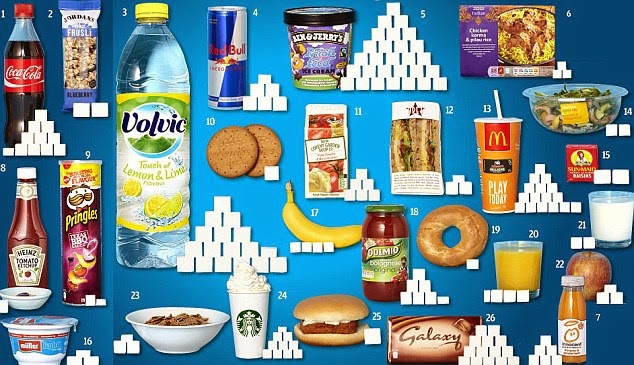
This chart gives you an idea of how much sugar is contained in some popular food items:
 (Photo Credit: funergirl.wordpress.com)

Names for Sugar - Look for these on your ingredient labels:


Other Links you might find helpful:
Your body will thank you for eliminating this toxic substance from your body, and I promise you will feel so much better. If you are interested in making this a lifestyle change (and you should!) here are some more tips on how to phase out sugar in eight weeks. Here is a "high 5" to being in control of your health! 
In Health & Fitness, 
Marissa
Get Fit! Be Fit! Stay Fit!
References:
Lustig, R. (2009, July 30). The Skinny on Obesity [video file]. Retrieved from
https://www.youtube.com/watch?v=dBnniua6-­‐oM

Sunday, February 8, 2015

My favorite 30 Minute Workout (or Less!)

One of my favorite workouts is with a jumprope and a kettle bell. I alternate 30 rounds of 40 seconds of jump roping with 20 seconds of kettle bell swings. If you don't have a kettle bell you can use a dumbbell, or skip the kettle bell swings all together and do my next favorite movement, burpees! (I promise to start uploading my own videos for movements.) 


You can also modify this workout to do each movement for 1 minute each. You can further modify this workout if you are pressed for time and do it for 20 minutes, 15 minutes or 10 minutes; alternating each movement for a 40/20 or 1 minute interval. 
A jumprope is inexpensive and only your body weight is required to do the burpees. Both movements allow you to increase your heart rate and build strength in your upper body and core. I use my gym boss timer which allows me to preset my times and beeps loud enough to alert me when to switch movements. 

One of the other reasons this happens to be a favorite workout of mine, is a few months back I did a "30 day 300 Kettle bell Daily Challenge" where I did 300 kettle bell swings for 30 days. So, during the 20 second interval, I was able to get in 10 swings which ultimately added up to 300 swings during the 30 minute workout and the jump roping was a bonus and a great way to add variety to the swings.

So, grab your jumprope (and kettle bell) and turn up the tunes. 3-2-1 Go!

Get Fit! Be Fit! Stay Fit!


Thursday, February 5, 2015

Building a Healthier You

Here a few fitness tips to help you get on track and stay on track:

1. Ask yourself “why do I want to get in shape?” What is your reason for getting in shape? What or who is your inspiration and motivation? Make a vision board of photos, motivational statements, vacation destinations, loved ones, a new outfit, etc., to help you stay focused on reaching your goals.
2. Create goals that are simple, measurable & realistic. Start with small goals first rather than jumping right in with both feet. For example, pick one thing you can cut out (sugar, pop, processed foods, cigarettes, alcohol, fried foods, etc.) and pick one thing you can add in (vegetables, water, whole grains, etc.) to your diet each week or once a month. Or, commit to going to the gym, or doing a yoga video 3 times a week at home if you can’t get out of the house. For some, it might not be realistic to cut out all bad food choices at once, or commit to going to the gym everyday, so start small. Be realistic, choose something you know you can and will do.
3. Find a good plan that you would enjoy & that fits your schedule. It’s probably not a good idea to join a gym to attend their 5am cycling class if you are not a morning person and just can’t get up. You are wasting money and remember what I said in point 2 about goals being realistic? Find something that is going to work for you. Maybe you have a gym at your place of employment and you can use 30 minutes of your 1-hour lunch to workout. Maybe you enjoy jogging and you have a neighbor that likes to jog too, commit to jogging together either in the morning or in the evening which ever fits into your schedules.
4. Partner up for accountability. 
Having someone to work out with makes a big difference. You will have times that it gets difficult to stay on track, but having someone to keep you accountable will help you keep going. If you don’t have a partner, or the means to work with a personal trainer you can always check out my “Get Fit with Ris” page on Facebook, I am always posting stuff there about exercise, good nutrition, and lots of great motivational pictures and videos to keep you motivated. Check it out even if you do have a partner, the more you have to keep you motivated the more successful you will be!
5. Make fitness fun.
 There are many different ways to get in shape. Find one that you enjoy and you will have a better chance of making this a lifestyle change. Fitness doesn’t have to happen in a gym. Look around your neighborhood, or your home. As you walk through your local park a bench makes a great place to do step ups or box jumps, push ups, tricep dips, and sit ups. You can change up an ordinary walk or jog by incorporating bursts of sprints, or walking lunges, burpees or jumping jacks. Head over to your local school and run the bleachers at the track. You do not need much, you just need to get started and stay committed.
6. Schedule your workouts. Your workouts should be just as important as anything else you do during the day such as going to work, attending a meeting, or going to school. Make time during your day to get in at least 20 minutes of heart pumping activity.
7. Walk before you run.
Take this process one step at a time. You want to set attainable goals so you stay motivated as you go and don’t get discouraged. Maybe you will start by taking the stairs instead of the elevator, or parking further away from the door. It’s never a bad idea to check with your doctor before beginning any type of exercise program, especially if you are new to it.  
9. Have a balance of Cardio, Strength, & Flexibility. You need 20 minutes of cycling, jump roping, rowing, or running to increase your heart rate. I’m not talking 20 minutes while you have a conversation (you shouldn’t be able to have a conversation) you should be “breathless”. You will want to include some strength training exercises which are very important for building lean muscle mass and aids in burning more calories when your body is at rest (yep, you read that right). Make sure you include yoga or some regular stretching during the week to increase and maintain your flexibility.

10. Keep a Journal. Journaling is proven to help individuals stay on track. Writing down your meals, beverages, snacks and workouts is a great way to identify patterns, both good and bad. Make sure to write down the time, the quantity, the meal/snack, and what you were doing at the time. Here is what an entry may look like: 7:00am - ¼ cup cooked steel cut oatmeal with ½ cup skim milk, ½ banana, 2 eggs scrambled with 1 cup baby spinach and ½ cup mushrooms,1 cup black coffee. Reading the newspaper. The reason we look for the “activity” is to determine if you have a habit of eating while watching tv (people tend to eat more, especially during action movies), sometimes you will recognize eating patterns that result simply from boredom, etc. These are habits you will want to address, or replace with healthier options such as cut up vegetables instead of potato chips, for example.

11. Eat often and don’t skip meals. Forget the breakfast, lunch and dinner mentality. You should strive to eat 5-6 or 6-7 small meals a day about 3 hours apart. My favorite is to think “meal-salad-meal-salad-meal-salad”. Staying within your portion sizes is important too. It is not necessary to “supersize” anything.

12. Don’t weigh yourself. Everyone is concerned about quick weight-loss, weight-loss diets, and what the scale says. What we should be paying attention to is a reduction of body fat. The bathroom scale is only going to show you the earth’s gravitational pull. It will not tell you how much lean muscle mass you have and how much body fat you have. Pay attention to how your clothes fit, did you go down a belt loop or pant size? If you are working out and building muscle, remember that muscle weighs more than fat and you will not see that improvement reflected in the scale with a lower weight. So don’t be discouraged what the scale says and pay attention to how you feel and how your clothes fit. To reduce unnecessary body fat it is necessary to burn (through exercise) more calories than you consume.

Here are some other links you might find useful:


Get Fit! Be Fit! Stay Fit!